Liked the article?
Share with friends!

Blog for English teachers
Here you can find the latest information for ESL/EFL teachers and tutors.
Games in English for children
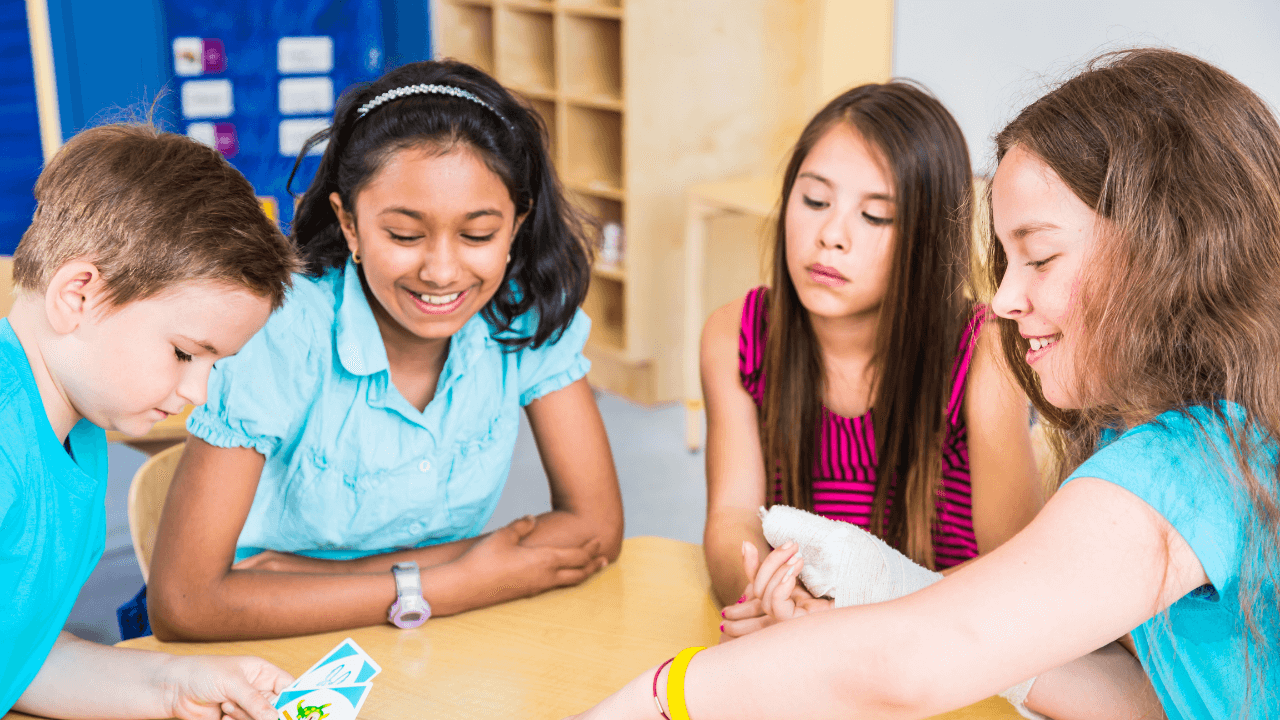
This article contains several sections on various games that allow children to learn English with interest. At the end of each section, you will find a link to an article dedicated to a specific type of game.
Educational and educational games
What traditional English games do you know? It may seem to an adult that they are all similar. This is partly true. After all, the main focus when we conduct educational games is repetition and increase in vocabulary. And the variety of rules is only an addition to the cognitive process.
Enrol now
Get your TEFL TESOL certification
Teach English! It is the best way to earn money.
Travel, work online, get a job abroad, or be
an EFL and ESL teacher in your country.
Get it nowTravel, work online, get a job abroad, or be
an EFL and ESL teacher in your country.
Development activities are divided into types:
- group or individual;
- mobile (walkers);
- desktop;
- phonetic;
- for the development of speech;
- online;
- card.
So that you can diversify your classes at school, in this article we have prepared examples for each of these types. The rules may change depending on the age of the students. Usually children aged 3-12 perceive the opportunity to compete well. Natural vocabulary training for beginners. Since learning expressions by heart without context is not a method. To build a strong base, you need to know: seasons, months, days of the week, clothes, family, acquaintance and body parts.
Games on the topic "Numbers"
Consider basic conversational games. They are suitable for ages 3 and up. There are no bulky offers here. Everything is directed to show how easy it is to count in another language. Mindfulness and memory are the main qualities for practicing numerals. After the lesson, the mother can easily repeat and check the memorization of the baby's words.
"What is missing?"
We lay out the cards with numbers on the table. Let's talk about each one together. Then we ask you to close your eyes and remove one number. When schoolchildren open their eyes, they remember the number that is missing on the table. Card games train attention and memory. Change numbers if you pass the first 10 digits, or tens and hundreds. Memory training and work on vocabulary.
"Stand Up When You Hear"
Emphasis on listening. The exercise changes perfectly depending on the vocabulary learned. You only need to select expressions from the unit that you have passed. Distribute number cards. Then start reading aloud or telling a story. The history should mention all these numbers. And every time you say one of them, the student gets up, repeats what he heard and shows the card. For children 5 years old, repeat slowly and clearly.
"Word Search"
Interesting ideas for memorizing English words are those that have a puzzle element. In front of the student is a set of letters in several rows, which at first glance looks meaningless. But below, the words are given, in our case the numbers that need to be found among this abundance. This is for memorizing English words. Develops mindfulness, spelling and spelling skills.
More games for memorizing numbers in English here.
English sounds
Sounding right is not easy. Law: as I hear, so I write, it does not work here. It is important to understand the difference between individual sounds and diphthongs so as not to mislead the interlocutors. The best way to explain this is playing with children. Say the words: bed and bad. Show the difference between the position of the jaw and the longitude of the sound. Such examples in the form of pictures of absurd antonyms will help students understand the importance of correct pronunciation. After all, everyone wants to be understood. Use a few ideas in your lessons so that the kids don't get overwhelmed.
"Tell me something beginning with..."
When the teacher says: “ Tell me something beginning with “b””, the team should remember more words with “ b ”. The wording changes depending on the material covered. Count points to determine the winner.
"The last sound"
The teacher throws the ball to each in turn with definitions. The task is to say the last sound. It helps well to show the difference between languages and allows you to form the correct pronunciation and reading. Given that sounds and letters sound different. This will help you feel the difference.
"Read lips"
When working on pronunciation, the main difficulty is the new position of the tongue and jaw of the speaker. In Russian, we have formed our own habit in this regard. Therefore, this is the best way to practice pronunciation. The teacher starts as a leader, then passes this opportunity to each guesser. Come up with a definition and pronounce it without sound. Children read lips and guess.
Work on a clear pronunciation is long and thorny. There are many aspects to focus on with each new level. Sounds, diphthongs, intonation - this is only a small part of what is to be learned about the production of speech. If you want to refresh or expand your knowledge of working with sounds in the classroom, read our article.
Games on the theme "Animals"
Speaking of animals, we often have outdoor games. We study them in order to voice our opinion about them. For example, who likes and why, where they live, what they are and how they help a person. It is important to choose the right content and generate interest.
Lexical Chair
Everyone knows the reaction game We put chairs in a circle. Their number is 1 less than the number of participants. Participants hear the names of the animals and walk in a circle without taking a seat. Our task is to name an extra object or creature from another topic. People quickly sit down, and the one who did not have enough space is eliminated. For teenagers, use herbivores and carnivores.
Enrol now
Get your TEFL TESOL certification
Teach English! It is the best way to earn money.
Travel, work online, get a job abroad, or be
an EFL and ESL teacher in your country.
Get it nowTravel, work online, get a job abroad, or be
an EFL and ESL teacher in your country.
"Hot Potato"
Another mobile method to cheer up. Take the ball and ask to remember the animals of those who have it in their hands. The ball cannot be held for long, so let them call the appropriate words quickly. Those who think for a long time are eliminated. Guaranteed to wake up excitement and fun. Another use case for this activity. Ask to remember the animals only for a certain letter that you think of. Such an exercise can be used with the topics "food" and "colors".
"Unscramble"
Effective teaching how to write the studied animals. All letters in words are mixed. The point is to guess which word is encrypted. You can write list of words on the board, or give each a list. Say it's for speed to make it more fun.
More animal games in English here.
Color games
"Colours"
Preschoolers love tasks using different items. Give the command: " Touch something red ". The students begin to quickly look for the red object. Count points for each found object to determine the winner at the end. Another phrase is bring me a green pencil.
"Traffic Lights"
It is best to memorize meanings in real situations, not abstract ones. You are in the role of a traffic controller. Name colors. Students must cross the road by showing which item of clothing of the same color they have. If this is not the case, then catch those who are trying to imperceptibly cross the road. Here we combine clothes and colors.
"Hangman"
A popular idea is the "gallows". The host makes a definition and writes the number of dashes, which is equal to the number of letters. The teacher can start, and then transfer this right to the winners of the tours. Children guess encrypted. They are called by one letter. If this is present, then we write instead of a pass. If not, the outline of a man appears. Teenagers will definitely like it, but for impressionable kids it is better to change the pattern.
More color memory games in English here.
Finger games
Tactile or finger games are important for the youngest English learners. With the help of intonation and movements, you help to develop fine motor skills of the hands and memorize vocabulary unconsciously. Understanding from 2 years. For learning English, the rhyme of the text is also important so that it sounds melodious and easy to remember. Teach with this method. Let's get to know him with examples.
"Hide-and-sick"
Touch your ears,
Pat your nose
Tickle baby's little toes,
Hide your eyes
Where are you?
Baby's playing peek-a-boo!
Accompany each phrase with a characteristic recognizable movement so that the baby understands the meaning of what was said. Show where his ears, nose and eyes are. Repeat the main thing several times and express with intonation.
"Three balls"
A little ball,
A bigger ball,
And a great big ball I see,
Now help me count them, One, two, three.
Use your palms to show the size of the ball and the verb to see. Show where the numbers are on the fingers at the end.
"Slap and shake"
Clap hands as slowly as you can
Clap hands as quickly as you can
Shake your hands as slowly as you can.
Shake your hands as quickly as you can.
Clap your hands slowly at first, then quickly during the first lines of the song. Then wave it with the handles at a similar pace. Slow down on the words slow and quickly.
Board games
How to motivate a student and arouse interest in him? Just play board games. They awaken a genuine interest in the process, and not just in the result. Don't correct students' mistakes in the moment. It is better to observe the process and write down the difficulties and mistakes. The right material is an important success factor. Consider the age and hobbies of your students. Give out prize chips or stickers to fuel your motivation. Students will love card games if the topic is close to them. Below you will find board games for different ages.
"My First English Alphabet"
3 year olds will be able to successfully cope and show off to their parents the knowledge of all the letters of the alphabet. The meaning of such “walkers” is to roll a die and “walk” across the field for a certain number of steps, completing tasks on the cards. The team consists of 2 to 5 people. Getting on the field with a letter, the participant must say it correctly. If he is already fluent in the alphabet, ask him to name any word starting with that letter. Keep score to determine the winner.
Soft sign English
Universal activity for preschoolers and adults. Playing with cards gives a visual representation of the subject. The task is to draw on the map and name objects that meet all the requirements of the card. The font looks very good, seeing cold, children will immediately be able to guess the properties, since it is written in blue in the form of ice.
"3D word"
Accent replenishment of vocabulary and fine motor skills of hands. Suitable for ages 6 and up. You can say topic and issue a constructor where all the letters of the alphabet are. On command, they begin to form expressions. Whoever has more wins. This is one variation on using a similar lexical constructor. You can adapt the conditions to the needs of students.
Try to introduce children's games with your students and you will understand their value. More information about board games can be found here.
Interactive online games
Many parents and teachers underestimate online games. Perhaps for them this way of studying does not look serious. However, in the current epidemiological environment, this is a safe path to education. Given the age, interests and level of the student, then homework for him will not be a burden, but a joy.
"MES English"
One of the ways to work with vocabulary. First, go to the vocabulary and listen, repeat aloud. In the question and answer, we do the same. And then we try to remember what we heard and choose the correct answer. Press question only to practice vocabulary and grammar. Here you can also find an abundance of worksheets and useful materials for your studies. Use flashcards to remember the past from the pictures.
"Games to learn English"
Interactive games with a huge selection. Each varies the level of difficulty and type of exercise. Begin by repeating what you have learned aloud. Then match the definitions with the pictures, look for the encrypted ones in the picture, or guess by ear. Answer questions or put everything in the correct order. Ideal for practicing speaking. To pass the level, you will need several lessons.
More online games for learning English can be found here.
Songs for children
An absolute favorite among the choice of exercises: children hear the correct pronunciation of words, and rhyme helps to remember them easily. The advantage of songs is simplicity. This is very convenient if you plan to combine repetition and new material. Few people realize that songs are a natural way to learn grammar. Since it is difficult for students of 3-6 years old to be given logical examples or explanations on situations, they get used not to speak, but to sing, grammatically correct.
- A variety of channels on YouTube allows you to choose topics and age of students. In such videos, the original voice acting of native speakers. Built-in questions in which the cartoon characters deliberately pause, allowing the guys to think. If you want to voice your own questions, feel free to stop the video and ask the students.
- You will meet bright animated characters on this channel. Toddlers learn about the weather, nature, animals and national holidays. The songs are very simple and catchy. There are also built-in questions. For example, given a picture, find red flowers or white clouds. And with the help of screen sharing in online lessons, you can highlight and color the correct answers live.
- Reading and writing exercises can be found on this service. With the help of funny songs English learners have to figure out what words are missing from the gaps and fill them in. It’s not scary if you can’t guess the missing one from the first listening. Listening comprehension is not easy. Make several attempts. Voice intonation the points that you should pay attention to.
- A huge variety of songs and tasks for them can be found here. Choose depending on the skill you are practicing today. Grammar, reading, listening comprehension! There are at least 5 tasks for practicing for each video. All in one place. Choose only age and level.
- Features of children's games in the classroom
Conclusion
We discussed interesting learning games that will increase engagement in the English language. The main difficulty in choosing such activities. There are so many nuances to consider: age, interests, language skills. Therefore, we decided to focus on the differences in these parameters. Detailed information in the relevant articles.
- When selecting material for elementary grades, we take into account their desire to move constantly. That is why melodies, dances are the best solution to direct children's energy into an educational direction. For example, the game crocodile. Bright colors, funny scenes and poems - this draws attention to the process. In the meantime, you ask questions by repeating new words.
- Middle school children will already have to select other material. Since their hobbies are different from the interests of a 5-6 year old. Find cartoons with meaning, where it is possible to study the plot and the motive of the characters. Also, reading modern literature will cause great interest. For girls there is a little mermaid, and for boys there is a spiderman. Pearson has no equal in this.
- In high school guys become more inquisitive and they wake up with a desire to prove themselves. Organize projects in groups with an opportunity to earn points. The game "Bingo", "Field of Wonders", "Guess the melody" and other similar tasks will have much more conditions in comparison with the previous ones. Here, students have to listen, discuss and defend their point of view.
Thanks to a large number of activity options, you have the opportunity to turn games for children into an entertaining and exciting process. In this article, we introduced you to only a small part of such activities. The teacher should successfully and accurately select the material for teaching. If you already have rich experience teaching young talents, share your thoughts in the comments. What language learning activities do you most often use in your classes?
Enrol now
Get your TEFL TESOL certification
Teach English! It is the best way to earn money.
Travel, work online, get a job abroad, or be
an EFL and ESL teacher in your country.
Get it nowTravel, work online, get a job abroad, or be
an EFL and ESL teacher in your country.
If you are interested in professional development, then the TEFL/TESOL course will be a great start for your future. Follow the link if you want to have time to participate in the program with a 50% discount.
🌟 Exclusive offer! 🌟
Get your TEFL/TESOL certificate 📜
and start earning by teaching English in your country, abroad, or online from anywhere in the world! Order the course with a 50% discount 💸 and receive as a gift the support of a personal coach 👨🏫 and job placement assistant! 🎁🚀 Hurry, limited spots available! 🏃♂️💨
Subscribe to our e-mail, 📩 to
Receive a 12-step checklist ✅ to increase income for English language teachers.
Discover the secrets to doubling your income from teaching English with our exclusive 12-step checklist! 🚀 This checklist is designed for English teachers who want to attract more students 🎓 and keep their interest for a long time. ❤️